Page Not Found
Page not found. Your pixels are in another canvas.

A list of all the posts and pages found on the site. For you robots out there is an XML version available for digesting as well.
Page not found. Your pixels are in another canvas.
Personal website of Aruna Jayasena, researcher in computer architecture and hardware security.
Free and Opensource Tools that can be used for Hardware Designing, Validation, PCB Designing, and 3D Modeling
Elaboration of my personal work setup
Published:
Version control is a foundational skill in modern software development, and Git remains the most influential tool in this space. This post provides a brief history of Git, an overview of the ecosystem of platforms built around it, and a short, instructor-focused guide to using GitHub Classroom for managing programming assignments.
Published:
Welcome to the second episode of the CrPT🔑 series. In this episode, I discuss lattices and how they are connected to cryptography. As we discussed in the introduction episode, since quantum computers are expected to break many current asymmetric algorithms, lattice-based methods have attracted growing interest as a promising post-quantum alternative. Lattice-based cryptography relies on the hardness of solving lattice problems, let’s look at the fundamental idea behind them.
Published:
Welcome to my new blog series CrPT🔑 that discuss about applications of cryptography. In this first episode, I will explore current trends in cryptography and their impact on various applications. With significant developments in Artificial Intelligence (AI) and recent breakthroughs in quantum computing, it is a great time to discuss the future of cryptography. This episode aims to examine the factors that will and will not influence the future of applications that rely on cryptography.
Published:
Android devices come with several security components that work together to protect your device and personal data. Here’s a simple explanation of who makes these components, their security implications, and how they collaborate to keep your device (data) safe.
Published:
A computer needs to communicate with the external world to perform tasks. To facilitate this, we have peripheral hardware. When these peripherals need to talk to the operating system, we have interrupts. In this episode of TinyOS🐞 tutorial series, we will be looking at interrupts and how to use them.
Published:
In this episode of episode of the TinyOS🐞 tutorial series, we will be looking at how to protect critical sections in processes using spinlocks.
Published:
In the MultiTasking episode of the TinyOS🐞 tutorial series, we implemented “Cooperative Multitasking”. Next in TimerInterrupt episode, we discussed how the RISC-V time interrupt mechanism works. If you have missed them, I highly recommend going through them before proceeding.
Published:
In the previous episode MultiTasking, we implemented a operating system with cooperative multitasking. However, without the implementation of an interruption mechanism, our system cannot support preemptive multitasking.
Published:
In the previous episode ContextSwitch of TinyOS🐞, we introduced the context switching mechanism under the RISC-V architecture. In this episode we will be looking at Multitasking in our DIY operating system.
Published:
In the previous episode HelloWorld of TinyOS🐞, we discussed how to print strings to the UART serial port for a specific processor on QEMU that utilises RISC-V architecture. This episode takes us further into the operating system territory, introducing the concept of “Context-Switching”.
Published:
Lots of researchers have been curious about my Docker setups. Docker is actually a super handy tool for research. So, in this article, I’ll walk you through the basics of Docker for engineers/researchers.
Published:
Welcome to the first and simplest episode of TinyOS🐞. In this episode we will be looking at memory map settings of QEMU and writing a simple HelloWorld program. If you missed the introduction article about TinyOS🐞, you can find it here.
Published:
TinyOS🐞 is a tutorial series about minimal operating system kernel implementation based on the comprehensive tutorial series mini-risscv-os. This operating system kernel is based on RISC-V instruction set architecture. Credits goes to the original authors of mini-risscv-os. A fully built environment is available as a docker environment. This tutorial will cover several chapters related to implementing a operating system from begining.
Published:
Previously we looked at the verification of Verilog hardware implementations. In this post, we will be looking at the verification of firmware or systems code. Here the hardware implementation is abstracted with Instruction Level Abstraction (ILA). This allows us to make complex verification problems more tractable.
Published:
This simple Linux kernel tutorial is based on the book “The Linux Kernel Module Programming Guide”. We are using Ubuntu to bind the examples.
Published:
In previous post, we discussed Racket and Rosette. This is the post where we are going to verify our hardware designs using the infrastructure we have developed so far. In a nutshell, we will be looking at verifying Verilog hardware designs with Rosette.
Published:
This post is focusing on the verification with Rosette. Rosette defines extensions on Racket programming language to uplift the process of verification of implementations. We introduced Racket basics in the previous post. To make things more interesting we have used Jupyter Notebook environment. This time we will be using Rosette in the same environment, which will make verification problems much more interactive and fun.
Published:
In this post, we will be looking at basic Racket programming. At the end of the post, we will be doing some Racket programming exercises on the Jyputer environment. If you missed the previous post, where we looked at setting up the environment for the RackeTutes tutorial series, you can check it out from here.
Published:
RackeTutes is a tutorial series for Racket and Rosette solver-aided programming language to promote “Secure and validated” hardware designs.
Published:
This article is based on a talk conducted by Professor Jack Dongarra, who is a world renowned expert in numerical computing and tools for parallel computing and also the Turing Award winner in the year 2021.
Published:
So far we looked at implementing firmware for bare metal use cases. But you may have seen that in most of the hardware SDK’s, they suggest using a bootloader to load your programs.
Published:
In this episode of the firmware tutorial, let us build a firmware linker script from scratch for picoRV processor. You may remember in the previous tutorials we have used sections.lds to get the elf file. This linker file contains information about how much memory is available in our system and where and where specific hardware components use the memory so that the compiler can place different functions appropriately.
Published:
In the previous article, we looked at the different steps involved in the process of compiling firmware that is ready to run on actual hardware. For that, we have used the default firmware given in the picoRV repo. In this article, we write a very simple program from scratch to print “HELLO WORLD” to the UART output of the picoRV processor.
Published:
In this tutorial, we are going to look at writing firmware for an embedded hardware device. This tutorial is solely focused on simulations. However, it can be synthesized to work on FPGAs.
Published:
XOR neural network is one of the basic and simplest neural networks. It is trained by XOR gate input as input features and XOR gate output as the prediction. A basic XOR gate can be created using 3 layers neural network. The architecture that I have used and how I inferred it on FPGA is discussed here onwards.
Published:
This article is about two incidents that happened in the past, creating catastrophic tragedies due to mistakes in simple lines of code. Incidents like this signify the importance of verification of the systems that we build.
The Automatic Implementation of Secure Silicon (AISS) program aimed to reduce the complexity and overhead associated with developing secure integrated circuits. While this was a collaborative effort rather than an individual project, I contributed to AISS during my graduate studies.
GSI stands for Generic System Image, based on the Android Open Source Project (AOSP). This is a collection of community-driven projects that I initiated, focused on reviving unique devices such as the Microsoft Surface Duo and Motorola Razr foldables with newer Android releases.
The GM Alpha platform serves as the foundation for several performance-oriented vehicles, including the third-generation Cadillac ATS and CTS, as well as the sixth-generation Chevrolet Camaro. In this series, I document a collection of practical upgrades that I have completed on vehicles built on the Alpha platform.
For a long time, the sound of a computer was defined by its cooling system. Spinning fans, constant airflow, and the background hum of machines running day and night were simply part of the experience. Today, things are a little different, now we can build surprisingly capable systems that operate in silence.
Published:
Real-Time Kinematics (RTK) GPS is a precise positioning technology that enhances the accuracy of standard GPS systems by utilizing additional information from reference stations. Traditional GPS receivers provide location information with an accuracy ranging from a few meters to several tens of meters.
Published:
Real-time depth map generation on low end FPGA with supporting 320x240 and 160x120 resolutions. The main objective of this project is to implement a reliable embedded system on a lower end FPGA with limited resources. This project is based on Disparity calculation based on Sum of Absolute Difference algorithm and creating a depth map.
Published:
Design files of the simple heavy lifting drone created for Drone enduarance race Sky of Icarus. The frame’s design incorporates reinforcement at critical stress points, such as motor mounts and landing gear attachments, to distribute forces evenly and prevent structural failure.
Published:
I had couple of Raspberry Pi CM4 boards with the lowest specs, each with 1GB of memory and 8GB of eMMC. Both of these specs are not great when you want to do some resource intensive computations with these single board computing devices. This became a limiting factor especially when trying to run heavier workloads, containerized applications, or even basic development environments.
Published:
Building a portable and capable router with RPI CM4 and Intel BE200
Published:
If you ever plan to install a fire extinguisher inside your Alpha chassis car, or take it to the track, you may already know there are several existing solutions for mounting it. The basic requirement in either case is having a fire extinguisher within arm’s reach inside the vehicle. However, most of the mounts I found online position it directly in front of the passenger seat, which can be intrusive for daily driving and may also interfere with or damage the OEM interior over time.
Published:
Around the time from 2015 to 2020, I was used to using Google Photos, and I was a fan of having an external storage that you can sync your device with and not worry about the storage. However, I slowly realize this is not going to be a scalable solution, speciailly if you have multiple devices and the quality of these captured images and videos becomes increasingly higher. Then I started looking at self-storage solutions that can be scaled well in the future while also being power-efficient, with enough redundancy, and accessible anywhere.
Published:
This is psuctl🔌; a small desktop Power Supply Unit (PSU) controller for a Raspberry Pi built around an ATtiny85. The goal is simple: make the Pi power on/off in a controlled way, and make the whole setup reliable enough that you can forget it exists.
Published:
In this episode I am documenting the process of retrofitting an electric vacuum pump for camshaft-driven vacuum pumps in LTG engines. LTG is the forced-induction version of the GM ECOTEC engine family, which was used in many GM models in traditional rear-wheel-drive configurations such as the Cadillac ATS and LTG Camaro. Naturally aspirated versions of this engine were also used in several other configurations as well. 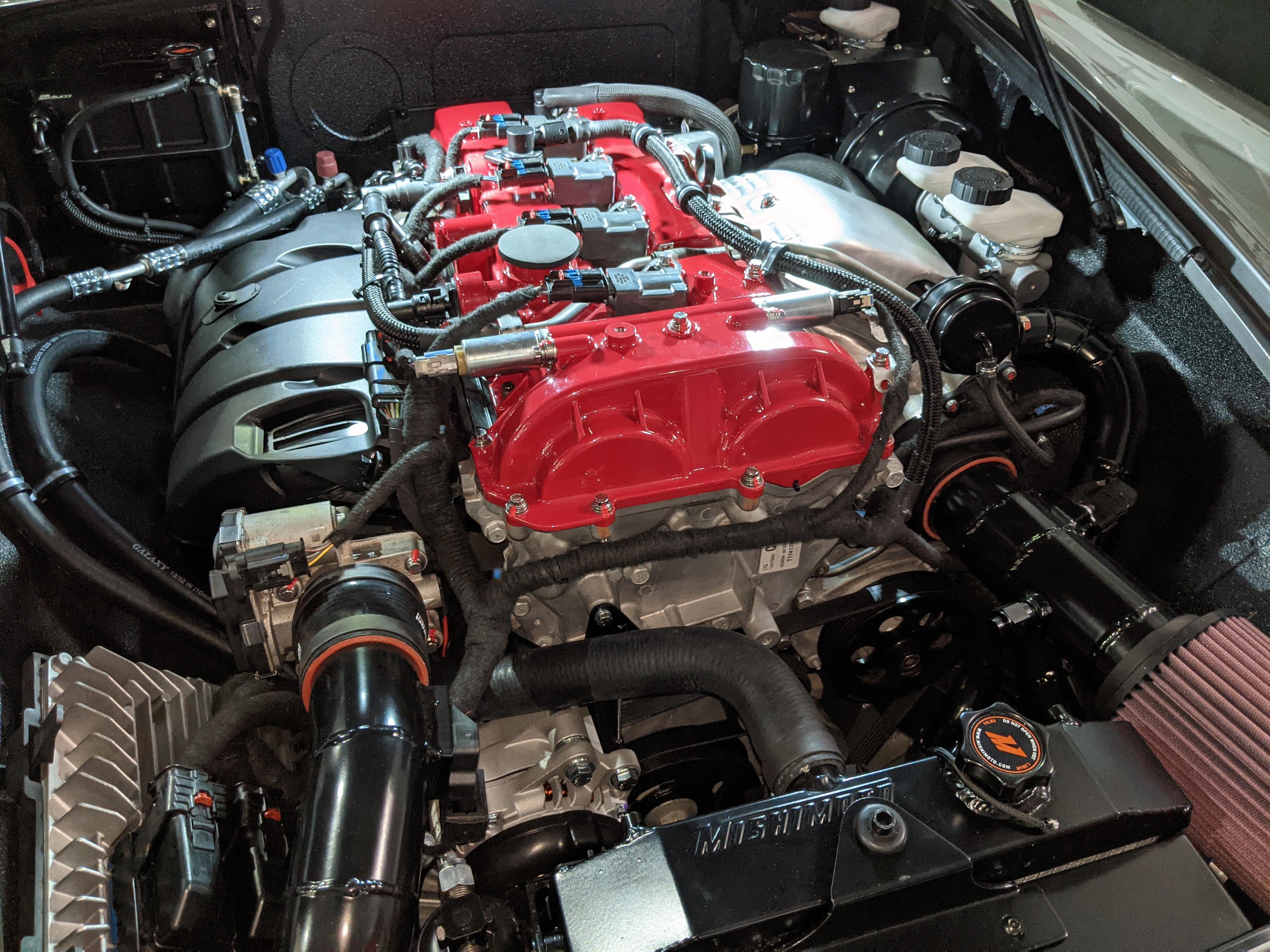 If you do some research about the LTG version of this engine, you will quickly find that it is an extremely versatile engine and has a lot of potential to make power. Being a turbo charged four-cylinder engine, it is surprisingly good on gas mileage as well with respect to the power it puts out. This engine is also very compact, making it a very good candidate for tight applications.
Microsoft officially ceased updates and support for the Surface Duo line in early 2023, marking the end of its interest in the dual-screen smartphone market. However, with AOSP GSI and the help of the opensource community, we duilt the Surface Duo Dual Experience (DUO-DE) custom ROM with OTA update support.
Published:
RAZR# (pronounced as “razor sharp”) is an Android GSI Project to bring a full Android experience to the Moto Razr cover displays. The Motorola Razr cover display is typically limited to vendor-defined experiences such as widgets, notifications, media controls, and Always-On Display (AOD) functionality. Android itself does not officially expose the cover panel as a fully interactive primary display.